publications
2026
- Frontiers CS ’26
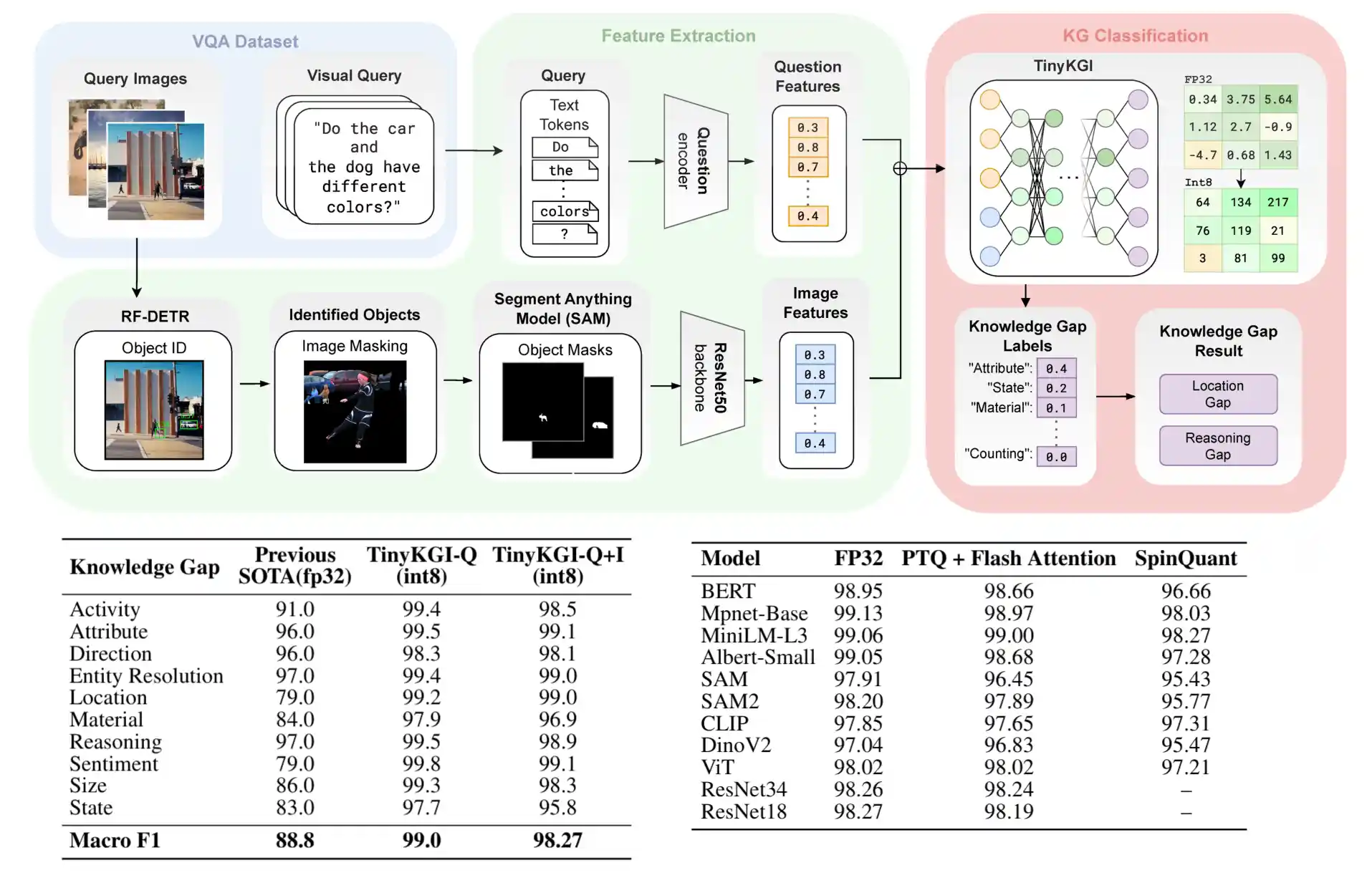 Identifying knowledge gaps on the edge for visual question answeringSarikaa Sridhar, S. Sai Ganesh, Goonmeet Bajaj, and 2 more authorsFrontiers in Computer Science, 2026
Human Cognition is complex and highly sophisticated system capable of accomplishing astonishing feats, partly due to our ability to seek out and overcome “unknowns,” or gaps in our knowledge, skills, and capabilities. Artificial Intelligence (AI) systems often draw inspiration from human intelligence, however, they often lack the ability to recognize when their knowledge is insufficient, leading them to provide answers even when incorrect. This limitation poses significant challenges, particularly in human-AI teaming and edge AI scenarios, where systems may lack requisite knowledge of the environment. To address this, we propose Tiny Knowledge Gap Identification (TinyKGI), a lightweight framework for automatically identifying plausible cognitive skills that the model lacks (i.e., Knowledge Gaps; KGs), which could lead to incorrect predictions. Our framework leverages human cognitive skills to structure how AI models reason and to define the types of Knowledge Gaps they may plausibly exhibit. By identifying insufficient cognitive capabilities, TinyKGI enables the development of more reliable and robust AI systems. TinyKGI uses a deep learning approach to classify different types of KGs for multimodal reasoning tasks while enabling efficient inference in resource-constrained environments. Through model quantization, we significantly reduce the memory footprint and execution time, resulting in a compact and lightweight model. Evaluated on three datasets, TinyKGI improves Macro-F1 scores by up to 10% over the previous state-of-the-art, while achieving up to a 1.8 × speedup and a 4× reduction in memory usage. We further evaluate TinyKGI on an edge device (Jetson Nano), where it achieves a 1.7× speedup and a 3.9× reduction in memory with only a 0.1% degradation in Macro-F1 score.
2025
- ICDM 2025
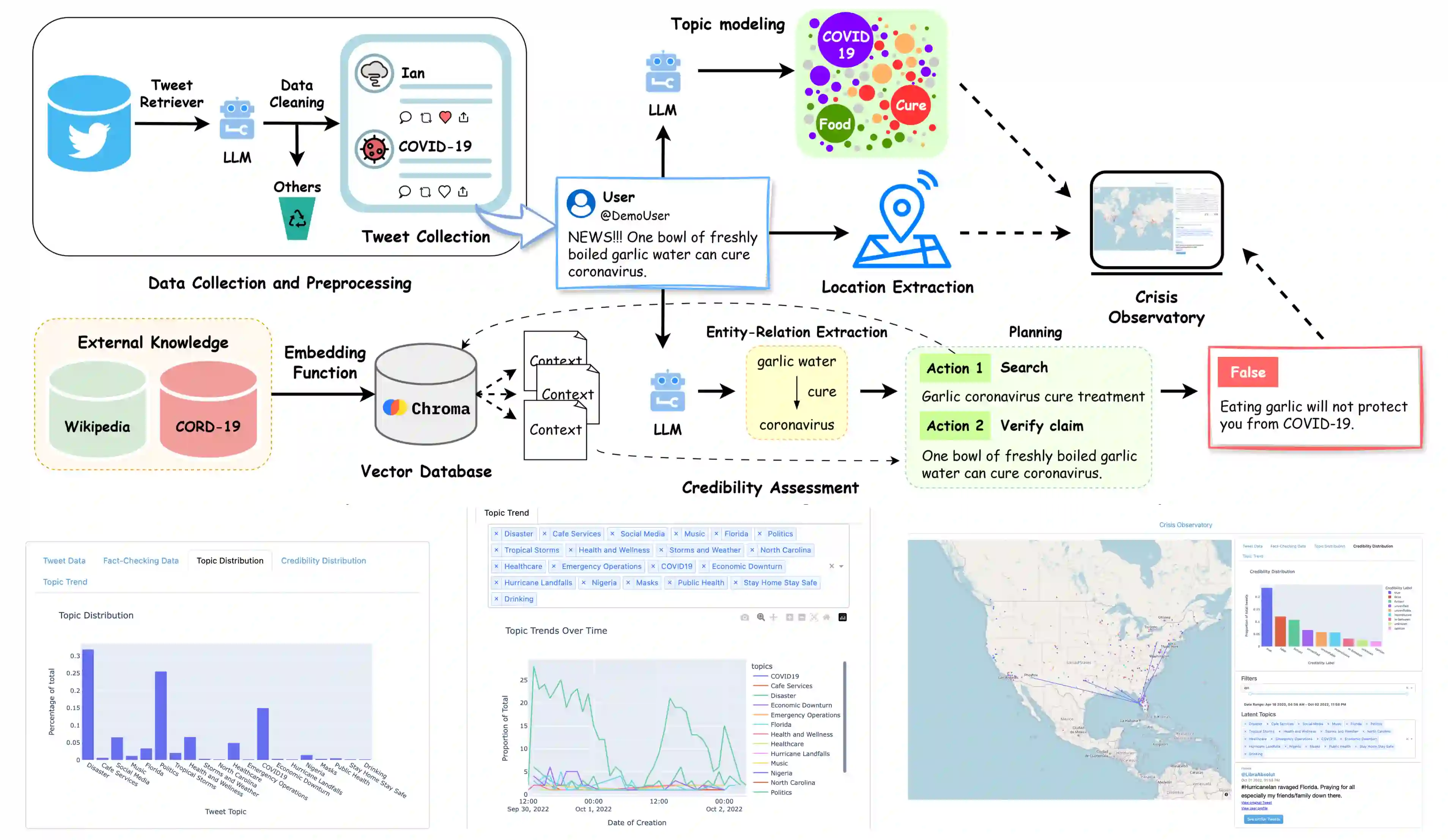 Crisis Observatory: Extracting Credible Signals During a Crisis in the Age of LLMsK. Lo, P. Maneriker, S. Sai Ganesh, and 8 more authorsIEEE International Conference on Data Mining (Workshops), Washington, D.C., Nov 2025
Systems for crisis response have required several different models for the analysis of unstructured text, such as identifying needs, locations, topics, routing, and matching of needs with available responders. Large Language Models (LLMs) have replaced task-specific models across various language processing tasks. However, LLMs are known to be limited by their training data, collected before the crisis. In this demo, we explore the use of LLMs for crisis response scenarios with rapidly evolving information environments. We show how augmentation of these models with external reliable sources of crisis-specific information can help build adaptive systems for response.