selected projects
- Multi-Agent Systems
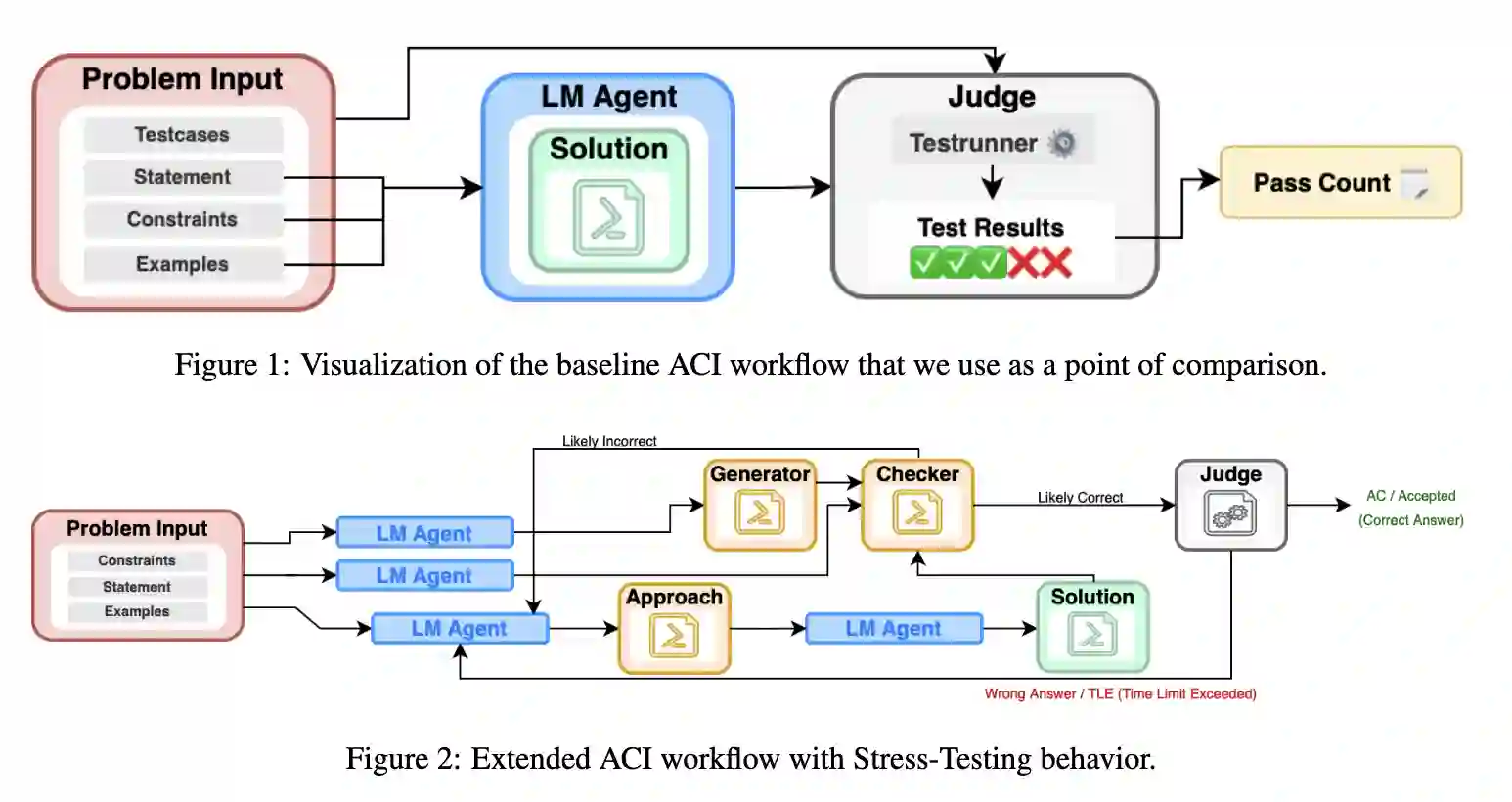 AutoAC: Agentic Self-Refinement for Competitive ProgrammingS. Sai Ganesh and R. PhamApr 2025
We introduce AutoAC, an agent-computer interface (ACI) for agentic self-refinement in competitive programming that couples LLM code generation with grounded feedback from an online-judge–style execution loop. AutoAC extends a baseline “prompt-solution-judge” workflow with (i) multi-agent chain-of-thought specialization and (ii) automated stress testing. Experiments on 300 problems from the CSES Problem Set across multiple open LLM families show that domain-specific CoT prompting improves partial correctness and that stress-testing yields substantial gains for stronger models; for example, on Qwen2.5-14B-Instruct, adding stress-testing to the best prompt condition increases performance by +5.97% NTPR and +6.33% SR (absolute). Overall, AutoAC demonstrates that embedding competitive-programming debugging practices into an ACI enables measurable improvements in reliable code generation under hidden-test evaluation.
- Multimodality
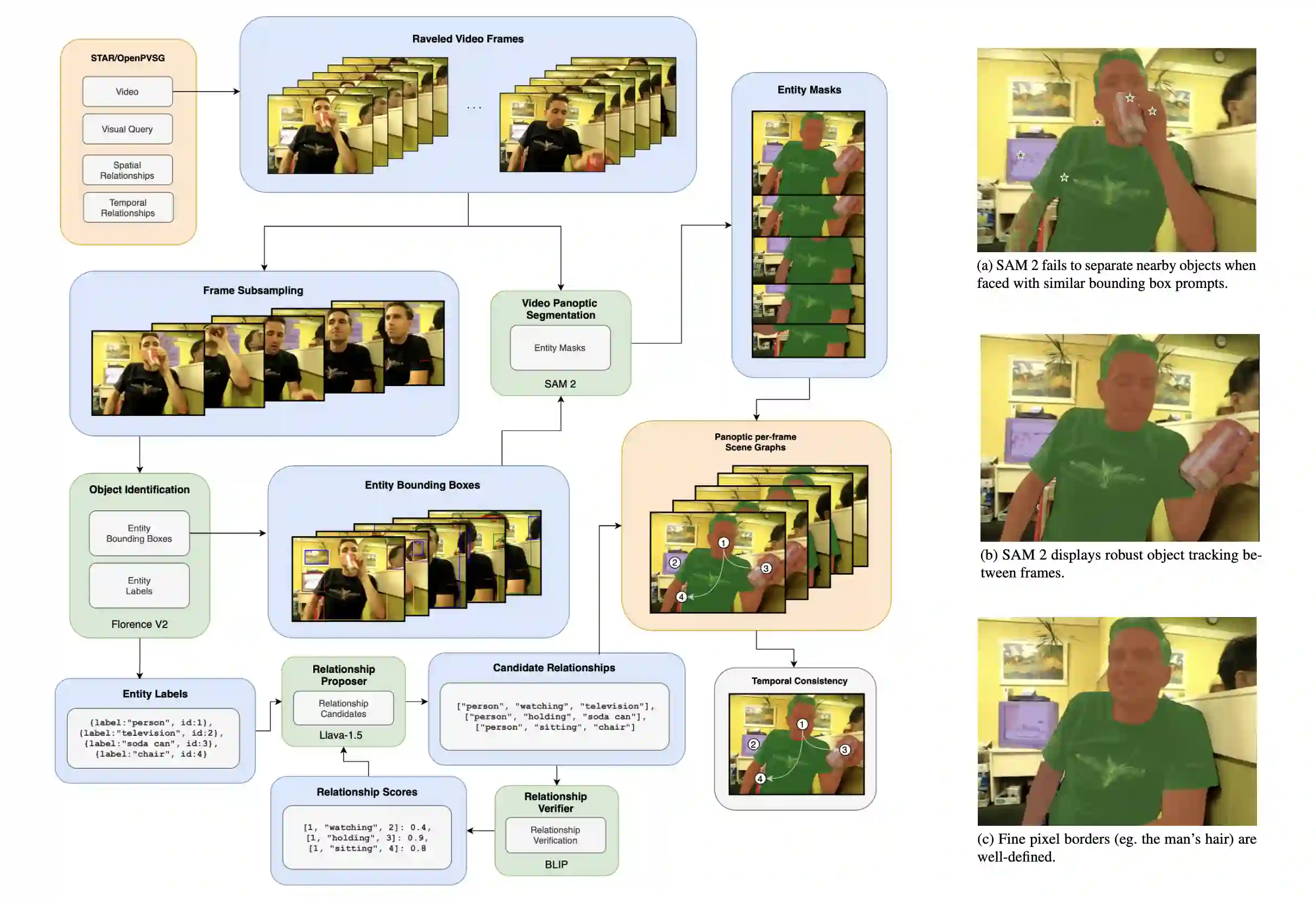 PanViS: Panoptic Video Scene Graph Generation for Zero-Shot Visual ComprehensionS. Sai Ganesh, M. Gandhi, and A. PuttaApr 2025
Scene graphs offer a structured way to represent visual scenes by modelling objects, attributes, and their relationships, greatly benefiting downstream vision-language tasks. Extending this to videos, Panoptic Video Scene Graph Generation (PVSG) aims to capture fine-grained spatial and temporal interactions through pixel-level segmentation and coherent dynamic graphs. However, current methods rely heavily on costly annotations and struggle to generalise to novel concepts. We introduce PanViS, a modular and interpretable framework for zero-shot PVSG that leverages foundation models to recognise unseen objects and relationships without requiring scene graph supervision. PanViS builds temporally consistent scene graphs through four stages: object identification, panoptic segmentation, relationship identification, and relationship verification. By unifying pretrained models via lightweight prompting and refinement, PanViS achieves accurate, scalable, and generalizable scene graph generation. We further propose tailored evaluation metrics to assess scene graph completeness and their utility for downstream tasks like video question answering. Experiments on the STAR dataset would show its effectiveness in addressing challenges of entity disambiguation, segmentation consistency, and relational reasoning across time.
- Causal Inference
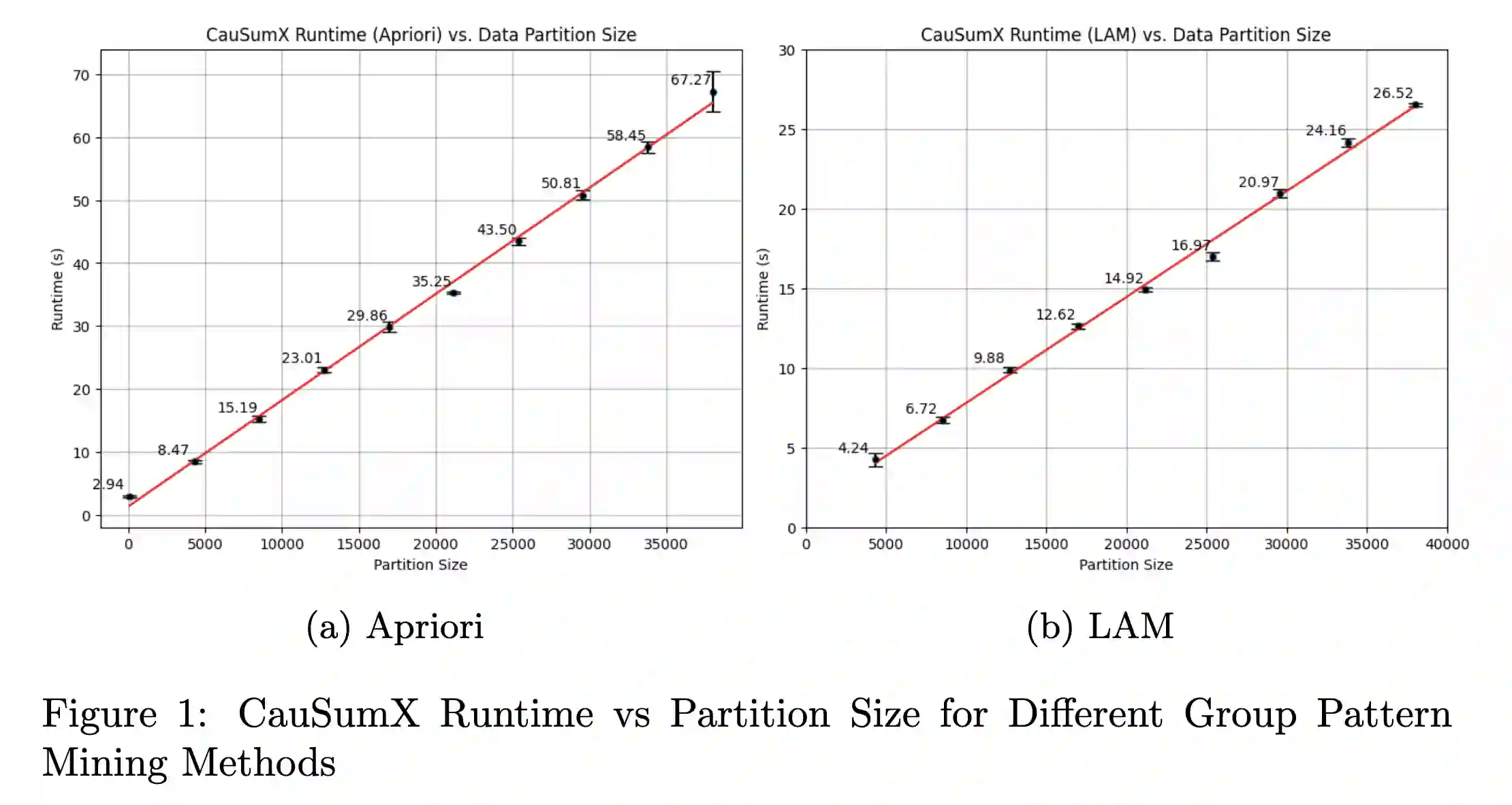 Distributed Summarized Causal Explanations for Fairness InsightsT. Vadlamani and S. Sai GaneshNov 2024
We propose a distributed approach for generating summarized causal explanations of fairness-relevant disparities in aggregate query answers, extending the CauSumX framework to settings where data are partitioned across sites. The method produces explanation patterns that relate outcome differences across subpopulations to high-impact treatments via conditional average treatment effects, enabling interpretable, group-level causal insights. Empirically, the distributed formulation preserves the ability to surface consistent fairness insights across partitions and highlights a key tradeoff between explanation specificity, overall explainability, and coverage of affected groups.
- Efficient ViTs
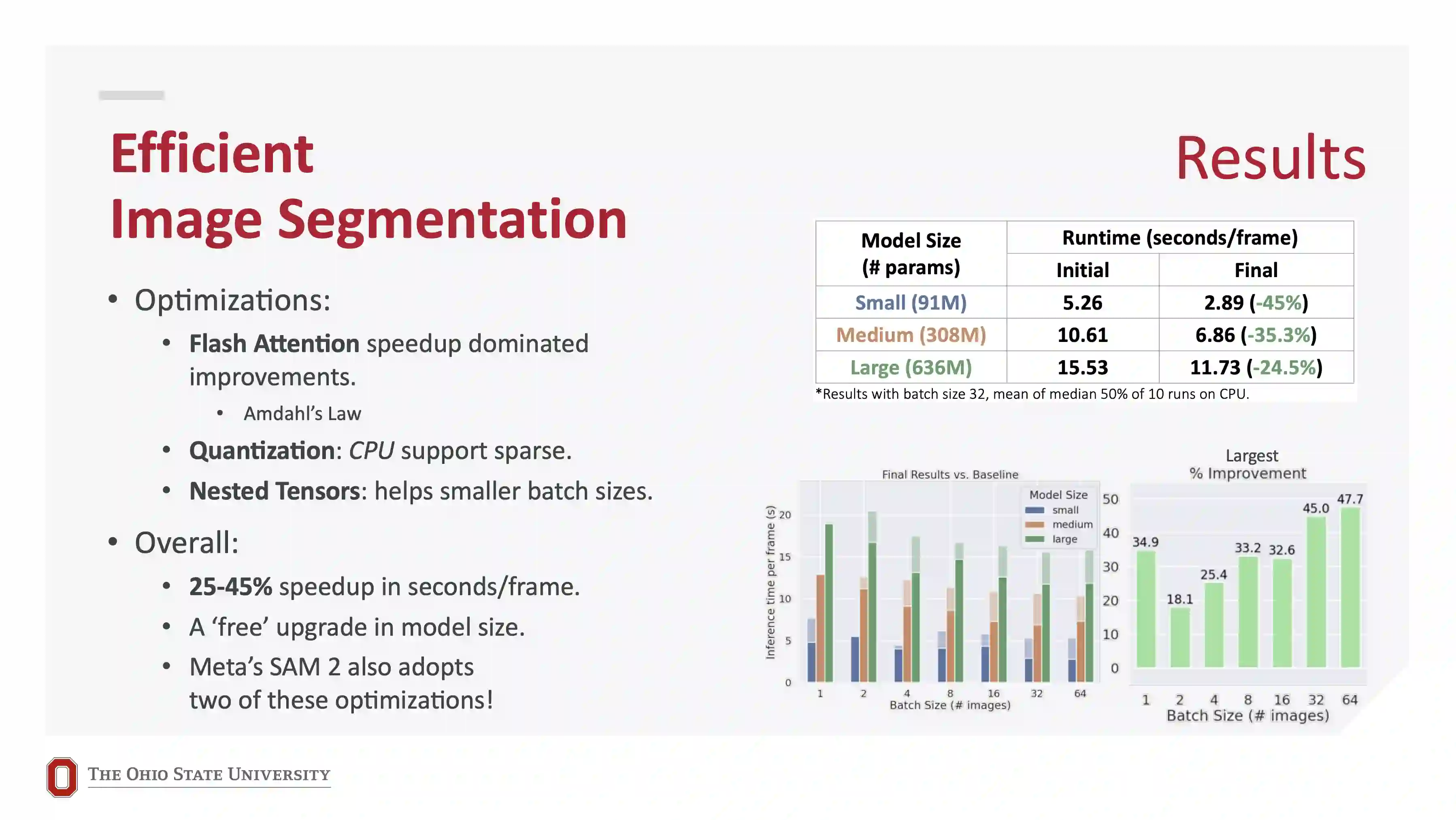 Optimizing Transformer Models for Image Segmentation on the EdgeS. Sai Ganesh and S. ParthasarathyNSF RISE Summer Research Opportunities Program, Nov 2024
Vision transformer-based (ViT) models have achieved state-of-the-art performance in computer vision tasks by effectively capturing nuanced global relationships between image features. Despite their success, these models are computationally intensive and challenging to deploy on resource-constrained edge devices without dedicated GPUs, such as drones and satellites. This work addresses the optimization of ViT models for enhanced resource efficiency, enabling high-performance inference on low-powered edge devices in a disaster response setting. We focus on Meta’s state-of-the-art Segment Anything Model (SAM) for semantic image segmentation, implementing a series of architectural and hardware-specific modifications to improve its viability for edge deployment. Our optimizations include (1) a faster attention mechanism, (2) post-training weight and activation quantization, and (3) PyTorch tensor operation optimizations. These enhancements result in an over 40% speedup in inference time with minimal degradation in segmentation quality on the SA-1B image dataset.